
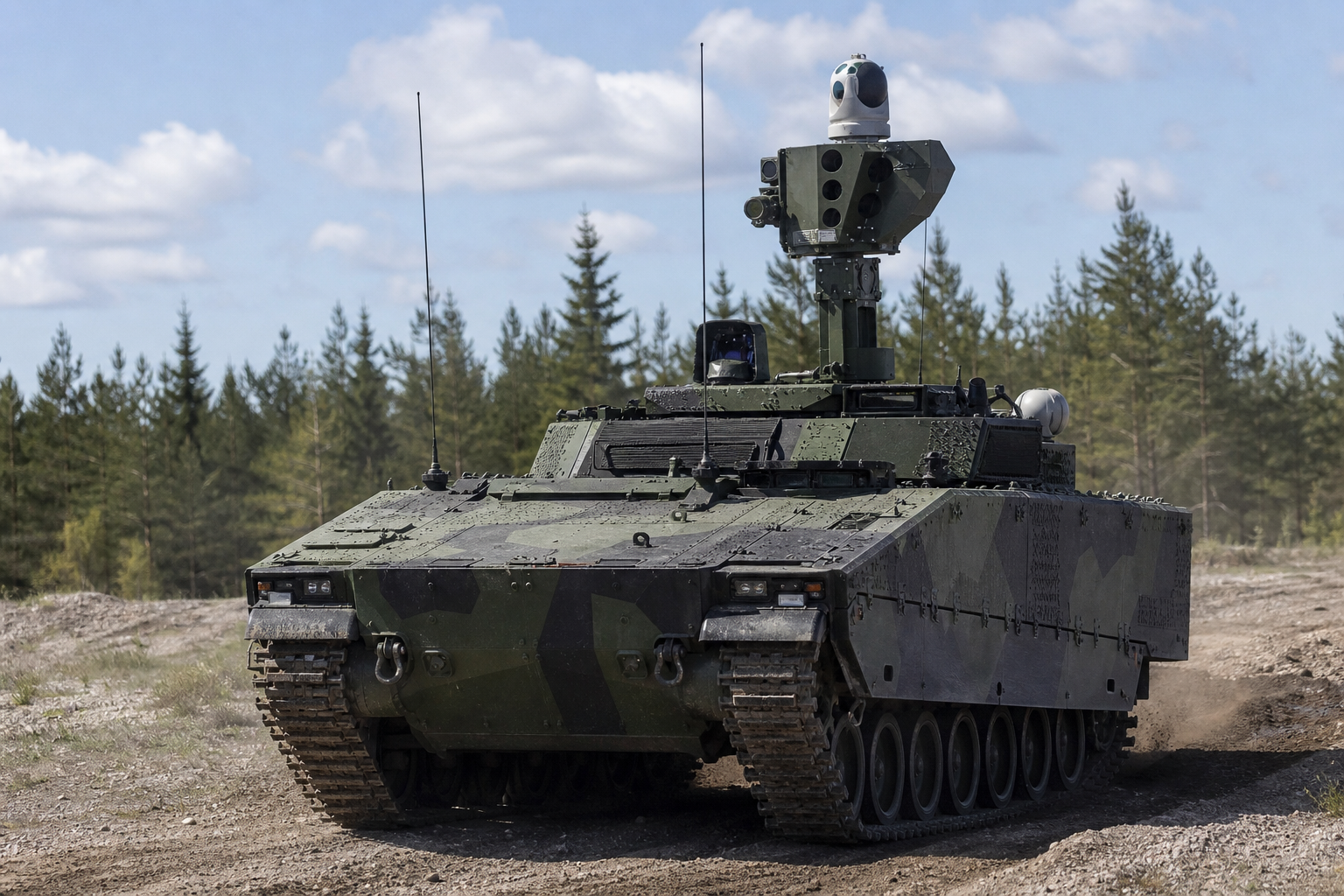
Estonian CV90 infantry fighting vehicles destroyed six quadcopters and multiple fixed-wing targets with precise 35 mm cannon fire during a live demonstration on 20 May 2025 at the Rutja training area.
The Siil 2025 exercise showcased the Marduk Piraya passive electro-optical sensor mounted on a CV9035. The system detected, tracked, and handed off targeting data for engagements reaching 2 km without emitting any signals that could reveal the vehicle position.
Warrant Officer Madis Lohu of the Scouts Battalion described the operational advantage. "One major advantage of Marduk’s system is that it doesn’t emit anything—it doesn’t put its operators at risk. It continuously monitors its field of view and flags potential aerial targets. Once confirmed, the Marduk system locks on and feeds real-time targeting data into the vehicle’s existing fire-control setup."
The Piraya sensor operates entirely passively, feeding confirmed aerial tracks directly into the CV90 fire-control computer. This integration allows the 35 mm Bushmaster III autocannon to engage small unmanned aircraft while the platform remains electronically silent within a layered counter-unmanned aerial system architecture.
Major General Andrus Merilo, Commander of the Estonian Defence Forces, observed the results. "It’s impressive that such a small target can be destroyed with essentially a single shot from a long distance. We can clearly see that the CV9035, already a highly capable vehicle, becomes even more effective with the addition of the right technical enhancements."
Estonia fields 44 CV9035 vehicles. In April 2026 the government halted a planned €500 million acquisition of new CV90 MkIV platforms. Funds were redirected toward counter-drone systems, unmanned aerial vehicles, and additional air-defense capabilities while existing vehicles receive electronics, weapon, and targeting upgrades expected to extend service life by at least ten years.
The Piraya integration forms part of a mobile, low-signature counter-drone layer positioned along NATO’s eastern flank. Because the sensor requires no active emissions, CV90 units can maintain defensive positions without increasing their electromagnetic signature, complementing higher-echelon radar and kinetic systems already fielded by Estonian and allied forces.