
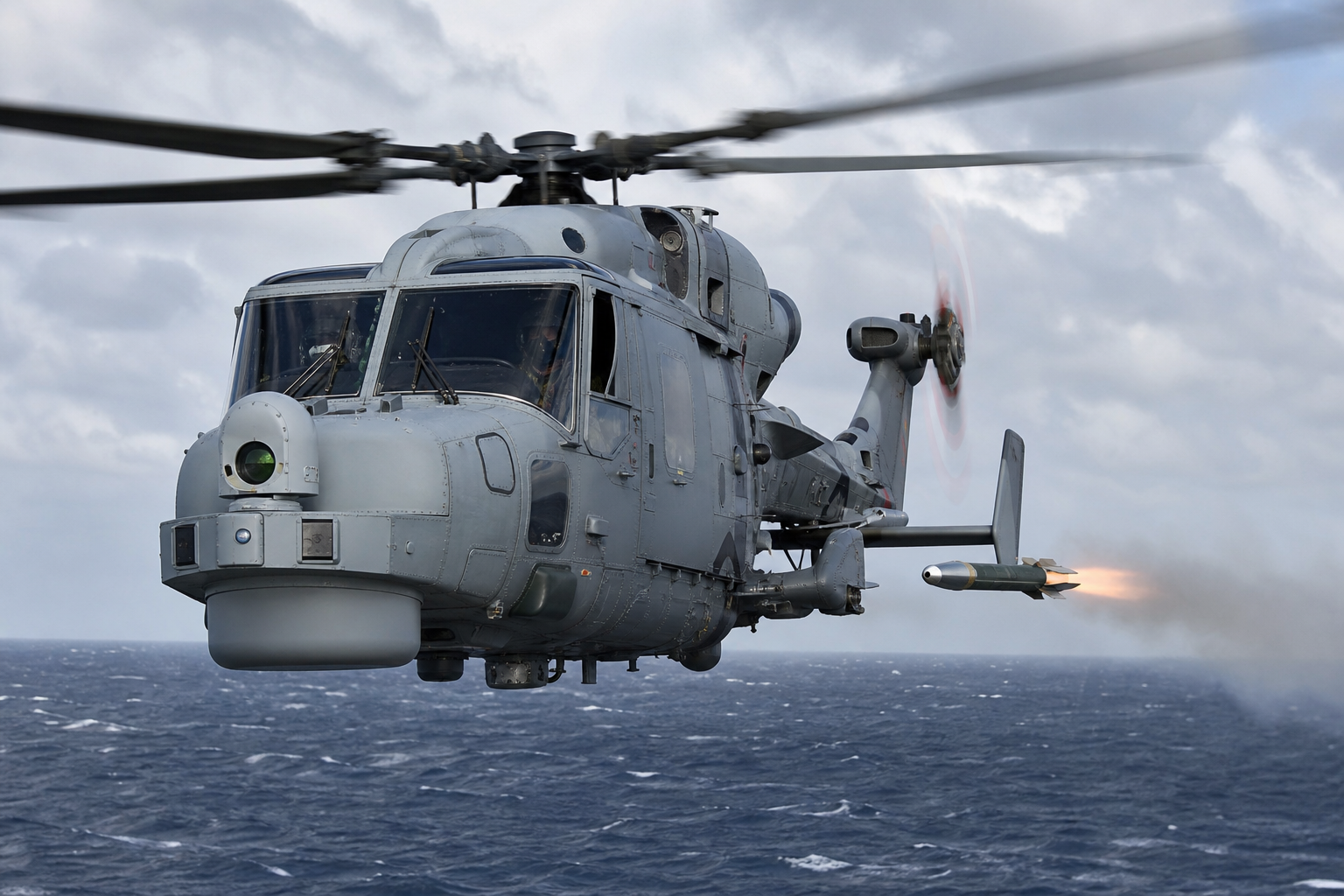
The Martlet missile system has reached full operating capability aboard Royal Navy Wildcat helicopters, expanding options for engaging drones and small surface vessels.
Trials completed before the May 2026 declaration confirmed performance against aerial and maritime targets at low altitudes. Each Wildcat HMA2 can now mount ten Martlet missiles on two five-round launchers, one on each side of the fuselage.
Thales produces the lightweight, laser-guided weapon at its Belfast site. The missile entered service in 2020 and is flown by aircrew from 815 Naval Air Squadron during routine maritime security patrols.
Martlet achieving FOC is a step-change for Wildcat.
Cdr Andrew Henderson, Commanding Officer of the Wildcat Maritime Force, made the statement following the formal declaration.
The weapon’s compact size and rapid salvo capability allow Wildcat crews to respond to multiple simultaneous drone threats without depleting other munitions. Operators can select individual missiles or ripple-fire sequences depending on target density and rules of engagement.
Integration testing focused on compatibility with the helicopter’s existing sensor suite and data-link systems. The missile maintains lock through terminal guidance even when launched from moving platforms in sea states up to four.
Security agencies monitoring proliferation of small unmanned systems now have documented evidence of a proven naval countermeasure deployed at squadron scale. The configuration provides a template for evaluating similar lightweight missile packages on rotary-wing assets used for critical infrastructure protection.
Further evaluations demonstrated the missile's reliability in various weather conditions and during night operations. The integration allows seamless transition between different mission profiles without requiring extensive modifications to the aircraft. Naval forces benefit from this advancement as it provides a cost-effective solution for neutralizing low-cost drone swarms that could otherwise overwhelm traditional defenses. The Royal Navy continues to refine tactics for employing the weapon in joint exercises with allied partners. Maintenance procedures have been streamlined to ensure high availability rates for the missile stocks carried aboard ships. This development marks a significant upgrade in the defensive and offensive capabilities of the Wildcat fleet operating in contested maritime environments.