
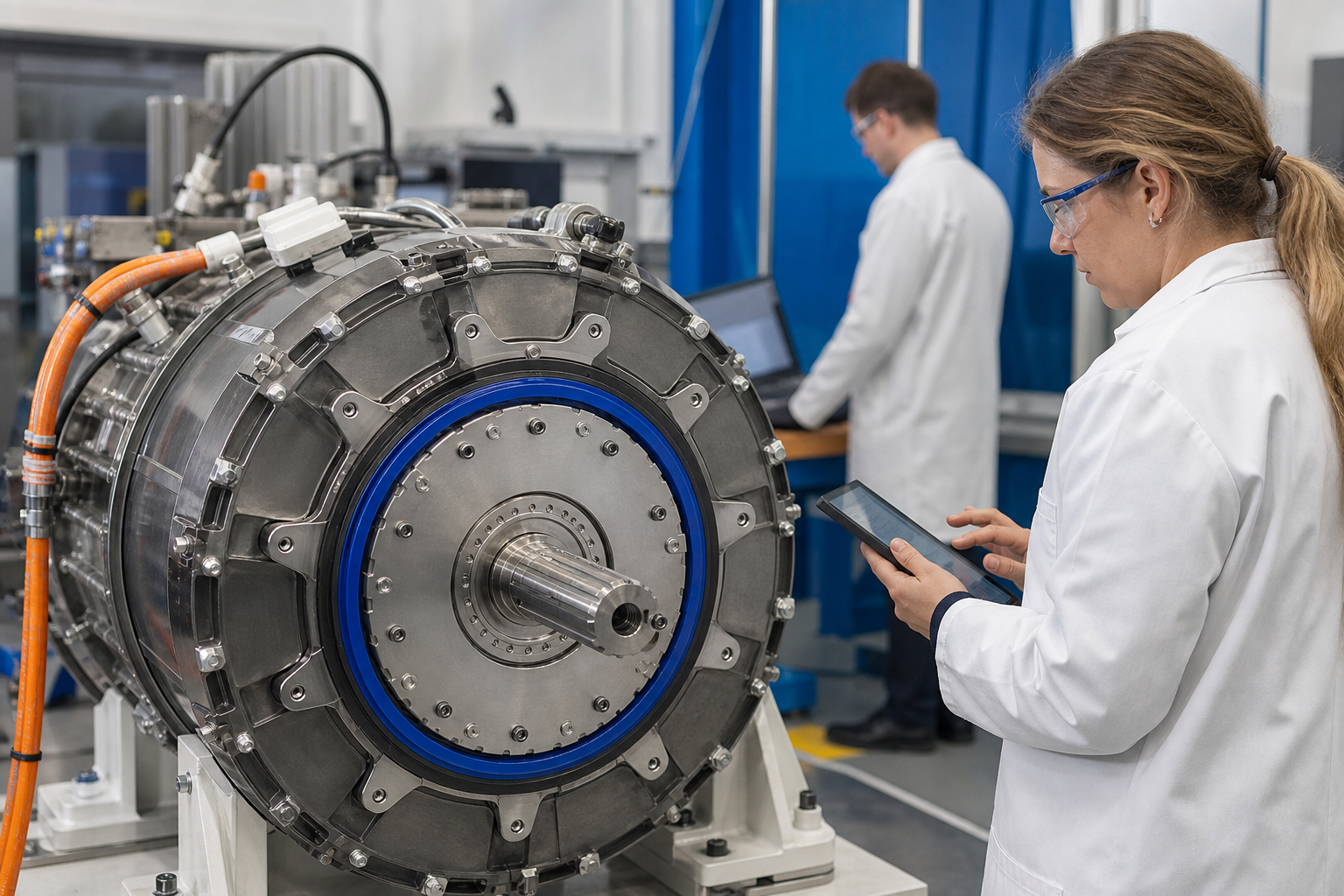
A 100 kW fully superconducting axial-flux motor completed operational testing at a university laboratory in Glasgow.
The demonstration occurred on June 2, 2026, at the Applied Superconductivity Laboratory of the University of Strathclyde. Engineers conducted the test as part of the Airbus-led ZEST1 programme, which targets zero-emission flight technologies for hydrogen-electric and all-electric aircraft.
The prototype ranks among the first fully superconducting axial-flux motors built specifically for aviation applications. High-temperature superconducting materials operate at 20 K to deliver a designed power density of 15 kW per kilogram, a figure intended to reduce overall propulsion system mass compared with conventional electric motors.
Axial-flux architecture places the magnetic flux path parallel to the motor axis, enabling a compact form factor that suits integration into aircraft nacelles or distributed propulsion layouts. Cryogenic cooling maintains the superconducting state during sustained full-power runs.
This demonstrator shows that fully superconducting aviation motors are no longer just a theoretical concept.
Professor Min Zhang, Lead of the Applied Superconductivity Laboratory at the University of Strathclyde, stated after the tests.
The University of Strathclyde News release and subsequent coverage in technical outlets including TechXplore and Electric Motor Engineering confirmed the motor specifications and test results. Researchers also published supporting data in an IEEE paper detailing the HTS winding design and thermal management approach.
Further work will examine scaling to higher power levels while preserving the target power density. The demonstration supplies empirical data on cryogenic system integration and fault tolerance that aircraft manufacturers require before committing to superconducting propulsion in future platforms.