
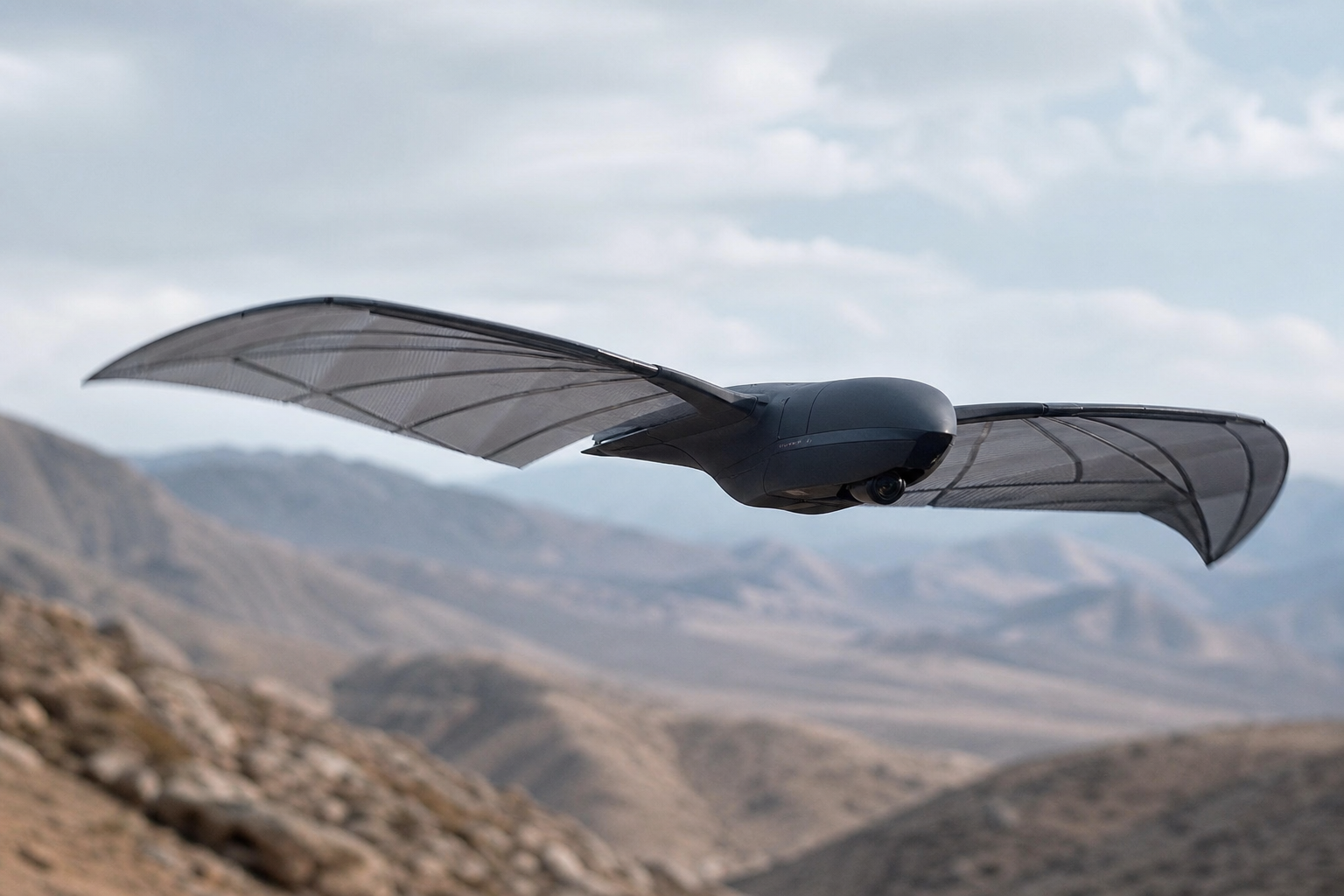
Bioinspired ornithopters equipped with smart materials promise stealthy surveillance capabilities for law enforcement agencies.
The Drone Radio Show episode titled Smart Materials and the Rise of Ornithopters, released May 25, 2026, presents Dr. Onur Bilgen discussing piezoelectric actuators and shape-memory alloys in flapping-wing unmanned systems. Bilgen serves as ASME Fellow and Associate Professor in the Department of Mechanical and Aerospace Engineering at Rutgers University in New Jersey.
Bilgen explains that smart materials enable precise wing morphing without traditional motors, reducing acoustic signatures critical for covert operations. These properties support hybrid drone designs that combine fixed-wing efficiency with rotorcraft maneuverability for urban environments.
Security professionals in sheriff offices and highway patrol units gain tools for persistent monitoring where conventional drones risk detection. Prison technology teams could deploy ornithopters for internal perimeter surveillance with minimal noise disruption.
Market data from OMR Global projects a 14.8 percent compound annual growth rate for ornithopter drones between 2025 and 2035. Defense and stealth applications drive primary demand alongside agricultural inspection needs.
Bilgen notes that bioinspired engineering transfers avian flight mechanics directly into actuator control algorithms. This approach improves energy recovery during wing strokes and extends operational endurance beyond battery limitations of multirotor platforms.
Rutgers laboratory prototypes demonstrate integration of piezoelectric fibers that respond to voltage changes for rapid camber adjustment. Shape-memory alloys provide structural stiffness variation during different flight phases.
Law enforcement agencies evaluating drone mitigation strategies now face ornithopters that mimic bird profiles on radar returns. Training programs may require updated detection protocols for low-signature flapping platforms.
The episode covers scaling challenges from laboratory models to field-ready vehicles suitable for tactical teams. Bilgen emphasizes collaboration between materials scientists and aerospace engineers to meet payload and autonomy requirements of public safety missions.