
Las Vegas police drones now reach most active calls ahead of ground units.
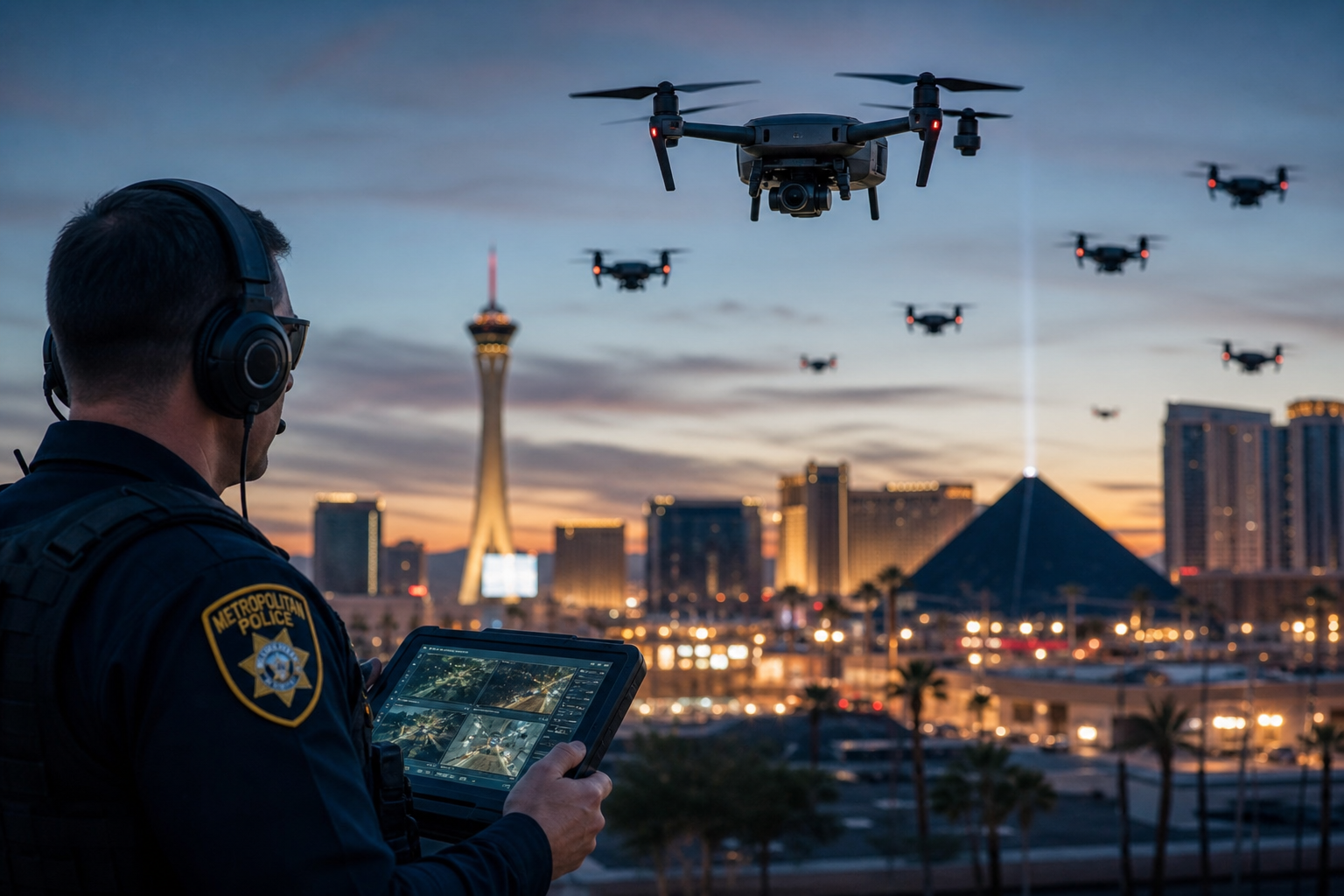
The Las Vegas Metropolitan Police Department operates 75 drones from 13 rooftop skyports under its Project Blue Sky program. These aircraft feed live video directly into the Fusion Watch Real-Time Crime Center, where operators fuse the imagery with facial recognition, automatic license plate readers, and additional sensors for continuous coverage.
The fleet averages 1,700 flights per month. Department projections call for as many as 20,000 missions in 2026 following the Phase 3 expansion that began in January.
Sheriff Kevin McMahill described the practical effect on response times.
"These drones are beating my police officers to calls 70% of the time... We're getting a bird's eye view of what's happening there long before we even arrive on the scene."
The integration allows center personnel to run facial recognition queries against live drone streams while cross-checking vehicle data from ALPR cameras. This sensor fusion produces actionable intelligence for patrol units already en route, reducing the time between call receipt and suspect identification.
LVMPD documentation lists the exact fleet size, skyport locations, and monthly flight totals. The same records detail how drone telemetry routes into the Fusion Watch platform alongside existing city camera networks for unified display.
Technical staff at the Real-Time Crime Center can task any of the 75 aircraft from a single console. The system maintains 24/7 availability, enabling rapid launch decisions regardless of shift or time of day.
Reports from KTNV News in May 2026 captured McMahill's assessment of the program's impact on officer safety and scene awareness. Coverage published by Police1.com in January 2026 outlined the skyport infrastructure and its role in scaling daily flight volume.
Law enforcement agencies tracking urban drone programs note the LVMPD configuration as a working model of combined aerial assets and biometric analytics. The department continues to refine flight protocols and data-sharing rules to support additional investigative uses.