
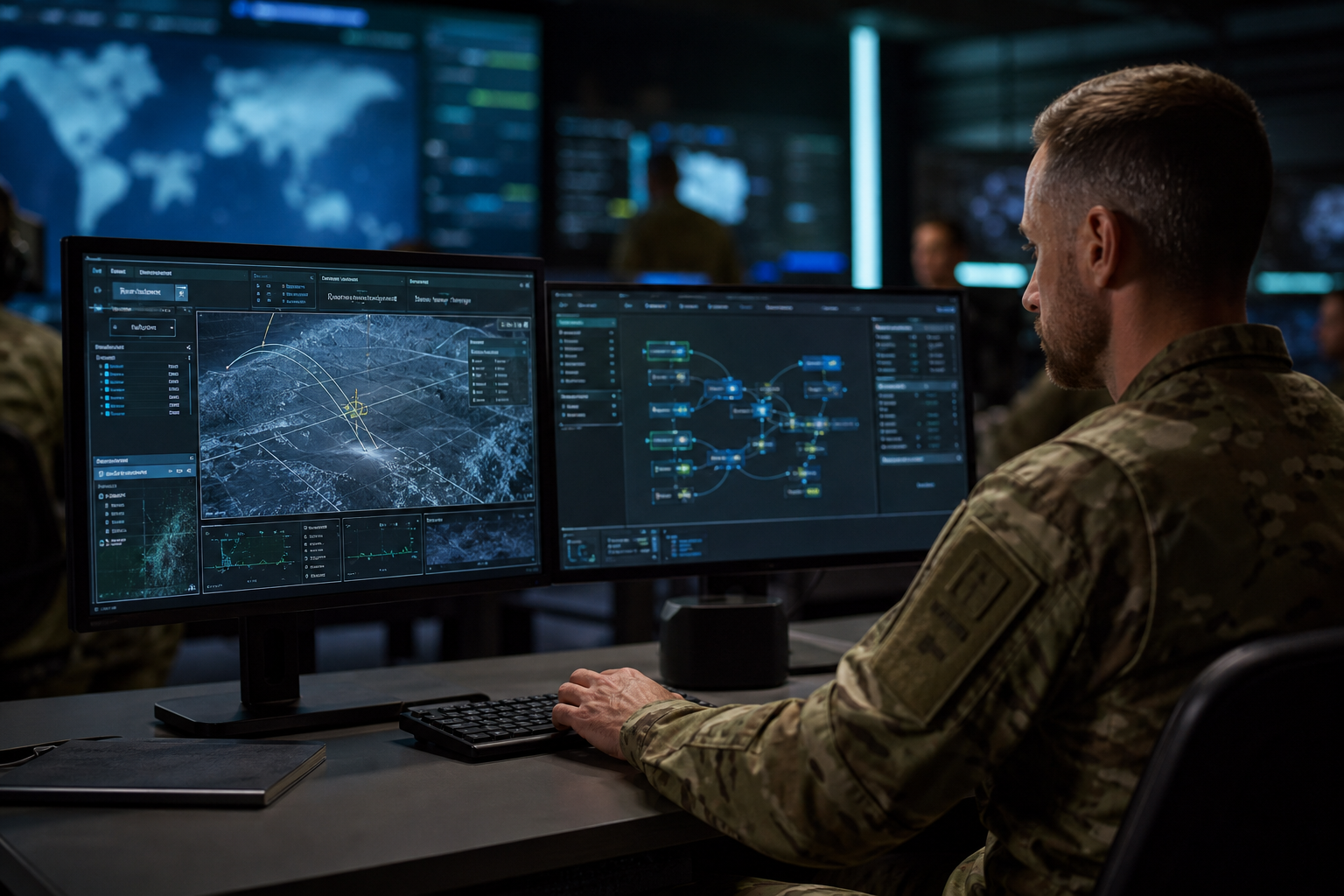
Control of engagement decisions in counter-UAS operations rests entirely with the software decision layer rather than any hardware component.
Al Vigier, chief executive of Caseway in Vancouver, advanced this position in an article published on June 2, 2026, on sUAS News. The Vancouver-based firm develops AI-driven automation tools for defence applications, including detection-to-decision pipelines used in intelligence, surveillance and reconnaissance missions.
Recent polling shows 82 per cent of Canadians want defence spending directed toward domestically owned companies rather than foreign prime contractors or their subsidiaries. Vigier ties this public preference directly to questions of operational control in contested airspace.
Hardware is not where sovereignty lives in a modern detection-to-decision system. It lives in the decision layer.
— Al Vigier, chief executive of Caseway.
Vigier argues that sensors, radars and airframes can be sourced internationally without compromising national authority. The critical element remains the software that fuses sensor data, applies threat classification and authorizes responses. Agencies that lack ownership of this layer effectively delegate final authority to external codebases.
The country that owns its decision layer controls its own engagement decisions. The country that does not is operating someone else’s kill chain and calling it independence.
— Al Vigier, chief executive of Caseway.
Caseway maintains a partnership with Valtec that allocates work so each national entity leads projects within its own borders. Under this arrangement the Canadian decision layer stays under Canadian control while the corresponding U.S. layer remains under U.S. control. The structure avoids shared code ownership that could create external dependencies during live operations.
For law enforcement and corrections agencies evaluating counter-UAS tools, the distinction carries practical weight. A system may detect small unmanned aircraft over a facility perimeter, yet the classification of intent and the selection of mitigation options occur inside the decision software. Retention of that software onshore preserves the ability to update rules of engagement without external approval cycles.
Vigier’s analysis arrives as Canadian defence procurement faces renewed scrutiny over foreign content. The polling figure of 82 per cent underscores domestic political pressure to prioritize companies headquartered inside the country when funding next-generation ISR and counter-drone capabilities.